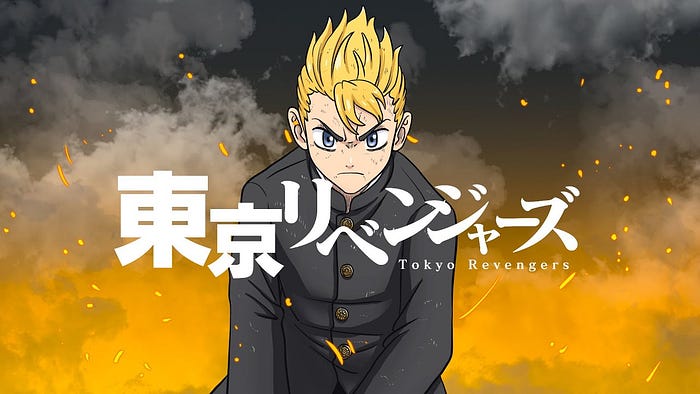
Tokyo Revengers is an anime about a guy named Takemichi Hanagaki, he is 26 years old and living in a small apartment, he hates his job, and has only ever had one girlfriend. He use to be in a gang until he left during middle school due to being bullied by a stronger gang that took over his school. Since then Takemichi Hanagakirealized he ran away from his past and was given the opportunity to travel back in time.
During his adventure in the past, he meets up with his girlfriend Hinata’s brother Naoto and tells him that his sister will die 12 years in the future. Because of this Naoto decides to become a cop and save her, and so does Takemichi.
The great thing about this anime is that when he goes back in time, he actually is able to come back to the present day. Each day spent in the past is a day spent in the present time but his body is in a state of suspended animation. Due to facing his past bullies and never backing down despite getting his ass handed to him over and over again, he gains respect and
friendship of the leader of the Tokyo Manji GangManjirō Sano!
When coming back to the present small things start to change and gradually his actions in the past ripple into the present. The anime has a great cast of characters each with a unique set of morals and life decisions. Without giving too much away the main goal of the character is to write his wrongs from his past, to maintain his relationship with his girlfriend, and to save her from her present fate. Takemichi’s goal is to save the Tokyo Manji Gang!
5 HEARTS OUT OF 5
ART STYLE AND ORIGINAL FACTORS
The art style for Tokyo Revengers is modern, clean, and very realistic. During fight scenes, you feel the character’s pain and during times of sadness, it’s almost like you are watching a friend cry. The anime focuses on light tones and bright colors that contrast its dark humor and also at times intense story.
All of the characters are very well-fleshed out and have unique backstories. The main character especially is such a good protagonist because you really care for him and his life, he’s the ultimate underdog.
*My only complaint is that I wish the anime had the main character go back in time and learn to protect himself even just a little because he is always getting his ass kicked, watching it makes me feel so bad for him. Also, the ending was way too much of a cliffhanger to the point that it makes you mad the way they ended it because it’s at such a good part.
AMC is an American Entertainment platform launched on February 29, 1980, mostly 43 years ago. It has its headquarters in New York and the United States. There is a total of 2,026 employees working with AMC as per the data of February 2022. It provides many services such as cable channels, streaming services, production studio, and independent film distribution.
With a subscription to AMC, you can stream content from various channels such as BBC America, IFC, AMC, and Sundance TV along with many of their movies and shows on demand.
If you are thinking about whether AMC offers a free trial or not, then let us tell you that AMC gives free trial services to users. In this blog, we will tell you How to get AMC free trial.
AMC free trial activation
Before getting started with the activation of the free trial make sure you have downloaded the AMC application to the device you want to stream the content. There are many ways to get AMC free trial described below.
Sign up on the AMC application.
Enter the required details.
Create a new username and password for your account.
Enter your credit card details.
After this, you will be provided with a free subscription for 7 days of the AMC trial.
You can also get a free trial by using third-party apps such as Amazon Prime Video. To get the subscription through Amazon, follow the below-mentioned steps:
Open the website of Amazon Prime Video.
On the window, a text would be displayed saying “Start your free 30 trial now.”
Then click on it.
Now you have to create a new account.
Enter the asked details such as Your full name, mobile number, email id, your payment method, and any other information if asked.
Now you should visit Amazon’s free trial AMC Plus.
And with this, you can stream AMC’s free trial services through Amazon Prime Video.
AMC Subscription Price
After discussing How to get AMC free trial, now we will tell you about the pricing policy of AMC which you will have to pay as a subscription fee if you want to continue with the services of AMC.
The charges of AMC vary from plan to plan.
If you purchase a standalone plan of AMC directly from the website, then you will be charged $9 per month.
But, if you purchase an annual plan of AMC then you will have to pay $83.88 which will result in a saving of $2.
If you purchased the subscription through any third-party application, then you will be charged a different amount. The amount may vary from app to app.
Final Thoughts
After learning how to get AMC free trial, you should try to use the free services even if it is just for 7 days. The content variety that is available on the application is vast which will surely entertain the users.
Canada is one of the world’s biggest Exporters of Agriculture Produce after other countries. In 2018, Canada produced the following:
20.3 million tons of rapeseed
3.5 million tons of dry pea
2 million tons of lentil
3.4 million tons of Oats (which made it the second-largest producer of Oats in the world)
Soy of 7.2 million tons
Barley of 8.9 million tons
13.8 million tons of Maize.
And many more. The list is not yet complete there are several other products as well but you got the idea of how big Canada’s agriculture production is.
In this blog, we will discuss Canadian Laws Regarding Agricultural Sector so let us begin with our blog.
Government Departments of Canadian Agriculture
Canadian Government has different departments divided for various functions relating to agriculture which are described as follows:
Department of Canadian Dairy Commission
Their role is to ensure that the producers get fair prices in exchange for their products. And to give good quality products to the final consumers.
Department of Agriculture and Agri-Food Canada
They formulate and regulate the policies relating to Canadian Agriculture, income earned from farming, development & research, and inspection and regulation of the animals and plants. This department is headed by the Ministry of Agriculture (Canada).
Department of Fisheries and Oceans
Conserving and making sustainable use of Fisheries resources is their main function.
Department of National Farm Products Council
The function is to promote agriculture practices in Canada and overseas. They promote Canadian Eggs, Canadian Turkey, Canadian Hatching Egg producers, and Chicken producing farmers of Canada.
Grain Commission of Canada
As the name suggests it is responsible for grains produced. This department is headed by the Ministry of Agriculture and Agri-Food.
Agency of Canadian Food Inspection
It conducts food inspection programs before allowing the food to be delivered to anyone. They also check the health of those animals which were being used in the process to check if any harm has been inflicted on them or not.
Agriculture Industry of Canada
Given below is a list of the agricultural industry of Canada:
Brewing Industry
Egg Industry
Forage Industry
Buckwheat Industry (It is used for mixes of Pancakes and Pasta)
Fish and Sea Food Industry
Fruit Industry
Dairy Industry
Confectionery and Chewing Gum Industry
Industry of Canary Industry
Grains and Oilseed Industry.
Industry of Maple Syrup
Bottom Line
The list relating to Canadian Agriculture Industry mentioned above is not yet completed because this industry is just so wide and is nearly impossible to cover every product. Farm Credit Canada and The Agricultural Credit Corporations are the two examples that provide loans to farmers at very low rates and also give the required training to the farmers and guide them on what they can do to enhance their product quality. Not only this but Canada has a large number of Profit and Non-Profit government-organized companies that are set up especially just to help the farmers in any way possible. We hope that this blog helped you providing some knowledge about Canadian Laws regarding Agriculture Sector.
Energy independence is a significant factor that shows how well a particular economy is performing concerning to its natural fuels. For an economy, it is essential to perform well both in terms of economic assets independence and financial resources as well.
So, in this read, we will try to study the reasons why can’t energy independence in the USA make its way out. And for this reason, we have summarized the whole content into a few highlights which are enough to let you understand the same.
Let’s have a cursory look at it.
What is energy independence?
Before diving into the complete concept, it would be quite better to have an insight into what “Energy Independence” is. It has been noticed that the term is explained incorrectly by many of us. Energy independence refers to adding up all of the economy's energy production comprising oil, natural gas, coal, and renewables, and then deducting the net energy consumption from it. The outcome shows the energy independence of that particular economy.
However, in this read, we will majorly be focusing on oil and gas production and the factors relating to it.
Understanding Behind-the-scene factors
The U.S. is the world’s largest producer of oil and gas despite its sourful public relations and the high volatility of the oil and gas industry. One of the major factors impacting the prices of oil is the war held between Russia and Ukraine. The war has impacted several countries adversely and has even influenced major working and pricing.
Let’s have a look at the other factors contributing to the hurdle in energy independence in the USA, and they are:
Ample of ready-to-use federal lands: The oil and gas industry has ample federal lands that are ready for use. Among the unused lands, around 5000 lands were approved in the year 2021. The number of lands that have been approved is about 6 times the average number of wells drilled in the past 5 years. But the current data reads that the number of lands approved are higher when put against the number of wells drilled.
Plenty of unused leases at disposal: The other factor concerning this issue, is that there are plenty of unused leases at disposal which are around 10 years of unused leases at the disposal. The oil and gas industries are currently producing nearly on half of the area.
New projects won’t cut down the prices: As per the recent study, it has been depicted that launching new projects won’t help in cutting down the prices or would lead to an increase in the supply in the short term. Energy independence in the USA is an era of plenty of fossil fuel energy. It has also been concluded that the new big oil projects are not fast, and safe. In addition to it, they are not expected to bring long-term solutions.
The Final Cut!!
The read was furnished to help in understanding the factors essential for bringing energy independence in the USA. This is so because working or improving these areas will help the whole economy to bloom and prosper. A timely and thorough monitoring of these aspects will surely help in bringing favorable outcomes.
The Your Name director’s mythic and comic new animation is an absorbing, intriguing and bewildering work
Here is the new animation from the Japanese film-maker Makoto Shinkai, whose 2016 fantasy Your Name captured moviegoers’ imagination and led him to be thought of as a new master and perhaps even the heir to Hayao Miyazaki himself. It is an absorbing, intriguing, bewildering work: often spectacular and beautiful, like a sci-fi supernatural disaster movie or an essay on nature and politics, but shot through with distinctive elements of fey and whimsical comedy.
Suzume (voiced by Nanoka Hara) is a lonely, smart teenager, who lives with her aunt after the death of her mother. While walking one day she chances across a mysterious young man called Souta (Hokuto Matsumura), who is apparently in search of a door. Fascinated and somehow nettled by this stranger and his eccentric quest, Suzume sets out to follow him, stumbling into abandoned ruins and finding a disturbing door in the middle of nowhere.
Like a modern Alice, she opens it – and appears to unleash vast cosmic forces and earthquakes. It appears that Souta’s mission was to seal up these calamitous portals; he says that his vocation is that of a “closer”, for which he needs a “keystone”. But a bizarre quirk of fate transforms Souta into a broken-down child’s chair that hobbles about talking in Souta’s voice, and as for the keystone, it takes the form of a talking cat called Daijin (Ann Yamane).
And so their adventures commence, at once vastly mythic and quirkily comic, and the resulting flavour has some undoubted charm. Suzume can be read at one level as about the seismic changes of adolescence and adulthood, but isn’t only (or maybe at all) about sex: it’s about status, respect and being seen. Suzume has something important to do, and of course what she has to do is protect nature itself, an idea with its own generational importance.
Suzume screened at the Berlin film festival, and is released on 13 April in Australia, and on 14 April in the US and UK.
… as 2023 gathers pace, and you’re joining us from India, we have a small favour to ask. A new year means new opportunities, and we're hoping this year gives rise to some much-needed stability and progress. Whatever happens, the Guardian will be there, providing clarity and fearless, independent reporting from around the world, 24/7.
Times are tough, and we know not everyone is in a position to pay for news. But as we’re reader-funded, we rely on the ongoing generosity of those who can afford it. This vital support means millions can continue to read reliable reporting on the events shaping our world. Will you invest in the Guardian this year?
Unlike many others, we have no billionaire owner, meaning we can fearlessly chase the truth and report it with integrity. 2023 will be no different; we will work with trademark determination and passion to bring you journalism that’s always free from commercial or political interference. No one edits our editor or diverts our attention from what’s most important.
With your support, we’ll continue to keep Guardian journalism open and free for everyone to read. When access to information is made equal, greater numbers of people can understand global events and their impact on people and communities. Together, we can demand better from the powerful and fight for democracy.
Whether you give a little or a lot, your funding is vital in powering our reporting for years to come.
With the state of events today, I think it is important to stay positive and find something fun to do. As such, with the growing popularity of online services such as Netflix and Hulu, I find it important to also introduce or entertain those doing something else – those watching Anime. By analysing its different aspects, such as its history and what makes it unique, my aim is to answer many peoples’ critiques, which argue that anime is unrealistic, childish, or plainly stupid. I also wish to provide the necessary information to those uninformed about the topic, which in return can allow them to try out a new long-lasting hobby.
For those that are unsure about what this article’s main focus is, I will give a short rundown. Anime, as it is known in Japan, is any sort of animation, or cartoon. The name isn’t even really an abbreviation of the English word “animation”, but instead is the way that the Japanese would say “animated cartoon”. Even so, its massive growth throughout the world jumpstarted the recognition that anime, simply said, is just Japanese animations.
Its history, interestingly enough, predates events such as the 1930s Depression, with the earliest ever animations being created around the beginning of last century. Following the Second World War, a culturally rich Japan would find itself under heavy influence of the United States. American brands such as Disney became leading motivations for Japanese cartoonists to open up in order to compete. This led to a 50s boom in entertainment, with studios for anime and manga blowing up across the nation – a good example is TōeiDōga in 1948, or Toei Animations as it is known now. Consequently, a depression in the 70s along with several new trends caused an explosion in the 80s, in accordance with the rising economy, as famous anime, including Dragonball and Fist of the North Star were born. The 80s epoque was key for the development of anime – for example, thanks to Dragonball, anime in the 90s such as Naruto and OnePiece, now regarded as classics, were created. Of course, this is without mentioning the growing popularity of anime outside of Japan, as the subject has received increasing international support ever since the 70s. Cartoons such as Sailor Moon depict this aspect well. The 21st century brought forward new innovative anime as well as continuing classic series. Implementation of new technology helped improve the quality of following shows, such as the amazing Code Geass and Death Note. In the 2010s, modern anime such as My HeroAcademia, Hunter X Hunter, Demon Slayer and Attack on Titan appear on the scene to amaze the world.
Anime is unique thanks to its focus on both storytelling and artistic animation – creativity is at the forefront of all good anime. Varying tempos in different anime pave the way great plot development, which bring forward the author’s imagination. Things often get turned upside-down in order to expose completely new and unexpected viewpoints, allowing you to dive deep into this alternate universe. Figuring out plot twists is also truly exciting.
When discussing anime, one also has to mention the artistic aspects. Its most distinctive features include the eyes, which are purposefully made larger and more colorful, the haircut, which often has an abstract shape and color, as well as physical traits, such as whiskers in Naruto’s case. Outfits also play a distinctive role in anime personalities – an iconic example is Luffy’s straw hat. In fact, many animators have stated their discontent with the rising pressures around drawing characters:
“The talk is that just drawing the eyes for a modern anime girl takes as much effort as it used to take to draw the entire bridge of the Space Battleship Yamato.”
Nevertheless, it is thanks to such ‘burdening’ effort that Japanese animators manage to blow the minds of billions of viewers throughout the world. This focus on the art and style of the production is what manages to set apart anime from normal cartoons such as Tom and Jerry. Each movie or series has a specific style which it respects. Asking 3 different artists to draw each other’s work would leave you with 3 different drawings for each work – nothing is the same. The variety in anime is also complemented not just by unique stories but also by the unique art.
As such, calling anime immature is a rather vague critique. Those who watch anime know that apart from the ‘notable Shounen’, which are oriented towards teenage boys, there are other shows which excellently depict the grit and weight of their universes. Much like movies, anime covers a wide range of age groups, as specific shows are not as appropriate for children. A child watching Dragonball Z would be able to understand the ‘superhero’ plot. However, if you show the same child Terror in Resonance, an anime about the motives behind terrorism, they won’t understand.
In all honesty, I myself thought anime was stupid. That is at least until my good friend introduced me to Tokyo Ghoul, after which I had a complete change of heart. As such, my message to anime critics is to watch the first 4 episodes of any popular anime within their preferred genre – afterwards, if you want, you can leave your impressions below.
Naruto drawn by Toriyama ((Dragonball creator) – middle) Original Naruto by Kishimoto (left) Krista’s eye from Attack on Titan (right)
This doesn’t mean that there is no reason to critique anime. There are several social viewpoints against it with which I agree. One of them is the over sexualization of women and the unrealistic expectations that it can set for both men and women about their bodies. This is of course within some limits, meaning that it doesn’t apply to all anime. Specific examples can be found in many Shonen anime, such as the 17-year-old Joseph Joestar in Jojo’s Bizarre Adventure and the 18-year-old Nami in One Piece. Much like Disney movies from the U.S, these exaggerated appearances and features can deceive people’s perception of beauty. On the other hand, I would say that an exaggerated character can be a complementary part of a show – wouldn’t it make sense for an exaggerated character to be part of an exaggerated story? There is also the fact that many of the artists behind the anime might simply be aiming to humor their viewers through imaginative exaggeration. This means that anime with weaker plots might be trying to impress or make people laugh through artistry, rather than making them feel attached, through storytelling. Such series often leave behind a bad reputation for those who are uninformed (e.g., ‘Food Wars’). Not to say that good-looking anime contains bad plot, of course – this is a generalisation. Still, there are lots and lots of anime which try to rectify their mediocre storytelling with flashy animation and jokes.
Joseph Joestar (JJBA S2) – left Nami (One Piece) – right
So, to conclude this article about anime, what I have covered is just a small part of the big picture. If there is one more thing I would want to add is that you should try it! Personally, I would say that it has granted me joy that I would never have otherwise discovered. It is good fun, it can be enjoyed with friends over plenty of online streaming platforms such as Netflix or Hulu, and it is most definitely a viable, interesting source of entertainment for all!
Information about featured image: Heroes from Shounen Jump – the most famous company behind Japanese youth entertainment. It is responsible for both manga and anime.
TOKYO — Business has never been better for Japanese anime. And that is exactly why Tetsuya Akutsu is thinking about calling it quits.
When Mr. Akutsu became an animator eight years ago, the global anime market — including TV shows, movies and merchandise — was a little more than half of what it would be by 2019, when it hit an estimated $24 billion. The pandemic boom in video streaming has further accelerated demand at home and abroad, as people binge-watch kid-friendly fare like “Pokémon” and cyberpunk extravaganzas like “Ghost in the Shell.”
But little of the windfall has reached Mr. Akutsu. Though working nearly every waking hour, he takes home just $1,400 to $3,800 a month as a top animator and an occasional director on some of Japan’s most popular anime franchises.
ADVERTISEMENT
Continue reading the main story
And he is one of the lucky ones: Thousands of lower-rung illustrators do grueling piecework for as little as $200 a month. Rather than rewarding them, the industry’s explosive growth has only widened the gap between the profits they help generate and their paltry wages, leaving many to wonder whether they can afford to continue following their passion.
“I want to work in the anime industry for the rest of my life,” Mr. Akutsu, 29, said during a telephone interview. But as he prepares to start a family, he feels intense financial pressure to leave. “I know it’s impossible to get married and to raise a child.”
Thanks for reading The Times.
Subscribe to The Times
The low wages and abysmal working conditions — hospitalization from overwork can be a badge of honor in Japan — have confounded the usual laws of the business world. Normally, surging demand would, at least in theory, spur competition for talent, driving up pay for existing workers and attracting new ones.
That’s happening to some extent at the business’s highest levels. Median annual earnings for key illustrators and other top-line talent increased to about $36,000 in 2019 from around $29,000 in 2015, according to statistics gathered by the Japan Animation Creators Association, a labor organization.
These animators are known in Japanese as “genga-man,” the term for those who draw what are called key frames. As one of them, Mr. Akutsu, a freelancer who bounces around Japan’s many animation studios, earns enough to eat and to rent a postage stamp of a studio apartment in a Tokyo suburb.
Tetsuya Akutsu, a freelance animator, wants to start a family, but on his wages, he said, “it’s impossible to get married and to raise a child.;Credit...Noriko Hayashi for The New York Times And it wasn’t so long ago that Mr. Akutsu, who declined to comment on the specific pay practices of studios he had worked for, was toiling as a “douga-man,” the entry-level animators who do the frame-by-frame work that transforms a genga man’s illustrations into illusions of seamless motion. These workers earned an average of $12,000 in 2019, the animation association found, though it cautioned that this figure was based on a limited sample that did not include many of the freelancers who are paid even less.
The problem stems partly from the structure of the industry, which constricts the flow of profits to studios. But studios can get away with the meager pay in part because there is a nearly limitless pool of young people passionate about anime and dreaming of making a name in the industry, said Simona Stanzani, who has worked in the business as a translator for nearly three decades.
More on Japan
A Corruption Scandal: Japan’s prosecutors accused Dentsu, an advertising company that was one of the driving forces behind the 2020 Tokyo Olympics, of conspiring to evade the public bidding process leading up to the Games.
A Video-Gaming School: Japan’s first e-sports high school thought it would turn out pro gamers. Instead, it attracted an unexpected demographic: absentee students.
Economic Growth: After more than two years under some of the world’s tightest border controls, tourist spots in Japan are packed. That has been good for business.
Yakuza on the Field: As Japan’s iconic gangster group faces a changed world and a waning appeal, a softball team is helping former members build a new life.
“There are a lot of artists out there who are amazing,” she said, adding that studios “have a lot of cannon fodder — they have no reason to raise wages.”
ADVERTISEMENT
Continue reading the main story
Vast wealth has flooded the anime market in recent years. Chinese production companies have paid Japanese studios large premiums to produce films for its domestic market. And in December, Sony — whose entertainment division has fallen badly behind in the race to put content online — paid nearly $1.2 billion to buy the anime video site Crunchyroll from AT&T.
Business is so good that nearly every animation studio in Japan is booked solid years in advance. Netflix said the number of households that watched anime on its streaming service in 2020 increased by half over the previous year.
But many studios have been shut out of the bonanza by an outmoded production system that directs nearly all of the industry’s profits to so-called production committees.
These committees are ad hoc coalitions of toy manufacturers, comic book publishers and other companies that are created to finance each project. They typically pay animation studios a set fee and reserve royalties for themselves.
While the system protects the studios from the risk of a flop, it also cuts them out of the windfalls created by hits.
ADVERTISEMENT
Continue reading the main story
Rather than negotiate higher rates or profit-sharing with the production committees, many studios have continued to squeeze animators, lowering costs by hiring them as freelancers. As a result, production costs for shows, which have long been well below those for projects in the United States, have remained low even as profits rise.
Studios are typically run by “creatives who want to make something really good,” and “they’ll try to bite off way too much and be way too ambitious,” said Justin Sevakis, the founder of Anime News Network and chief executive of MediaOCD, a company that produces anime for release in the United States.
“By the time they’re done, they have very possibly lost money on the project,” he said. “Everyone knows it’s a problem, but unfortunately it’s so systemic that no one really knows what to do about it.”
The same is true of the punishing nature of the work. Even in a country with a sometimes fatal devotion to the office, the anime industry is notorious for its brutal demands on employees, and animators speak with a perverse sense of pride about such acts of devotion as sleeping at their studios for weeks on end to complete a project.
In the first episode of “Shirobako,” an anime about young people’s efforts to break into the industry, an illustrator collapses with a fever as a deadline looms. The cliffhanger ending hinges not on her health but on whether the show she is drawing will be finished in time to air.
ADVERTISEMENT
Continue reading the main story
Jun Sugawara, a computer animator and activist who runs a nonprofit that provides young illustrators with affordable housing, began campaigning on their behalf in 2011 after learning about the penurious conditions endured by workers creating his favorite anime.
Animators’ long hours appear to violate Japanese labor regulations, he said, but the authorities have taken little interest, even though the government has made anime a central part of its public diplomacy efforts through its Cool Japan program.
“So far, the national and local governments don’t have any effective strategies” for dealing with the issue, Mr. Sugawara said. He added that “Cool Japan is a meaningless and irrelevant policy.”
Image
A game center in Tokyo featuring anime-inspired prizes. An activist said the government showed little interest in protecting animators from overwork.Credit...Noriko Hayashi for The New York Times
In an interview, an official from Japan’s Labor Ministry said the government was aware of the problem but had little recourse unless animators filed a complaint.
ADVERTISEMENT
Continue reading the main story
A handful have done so. Last year, at least two studios reached settlements with employees over claims that the studios violated Japanese labor regulations by failing to pay for overtime work.
In recent years, some of the industry’s larger companies have changed their labor practices after coming under pressure from regulators and the public, said Joseph Chou, who owns a computer animation studio in Japan.
Netflix has also gotten involved, announcing this month that it will team up with WIT Studio to provide financial support and training to young animators working on content for the studio. Under the program, 10 animators will receive around $1,400 a month for six months.
But many of the smaller studios are barely scraping by and don’t have much room to increase wages, Mr. Chou said. “It’s a very low-margin business,” he said. “It’s a very labor-intensive business.” He added that the studios “that manage to adapt are the big ones, the ones that are public.”
Not all studios pay such low wages: Kyoto Animation, the studio that an arsonist attacked in 2019, is known for eschewing freelancers in favor of salaried employees, for example.